
Say "I Got It Wrong": Building Real Trust on Large Capital Projects
Say "I Got It Wrong": Building Real Trust on Large Capital Projects
On this page
Around the world, large capital projects put owners, project managers, contractors, specialists and financiers into the same rooms under schedule, claim and reputation pressure. Kick-off photographs celebrate partnership. Mid-project progress packs are often carefully green. Yet the first honest sentence — “we do not know yet,” “I got that wrong,” “we need help on this interface” — is still rare. People “trust” packages to deliver because the contract says so or because past performance predicts it. That kind of trust is useful. It is still not enough. Across industries and jurisdictions, the same pattern appears: projects that cannot say “I got it wrong” early pay for the silence later in claims, rework and damaged relationships. The cost rarely shows as a line item called “lack of trust”; it shows as late change, disputed interfaces and teams that no longer believe one another’s reports. This comprehensive blog will explore what vulnerability-based trust means on large capital projects, how it differs from predictive and contractual trust and from a learning climate for speak-up, why armour is rational under multi-firm incentives, how real trust opens the door to hard debate without replacing the debate itself, and how leaders build and protect vulnerability-based trust in practice — including across owner and contractor lines.
1. The Armoured Progress Meeting
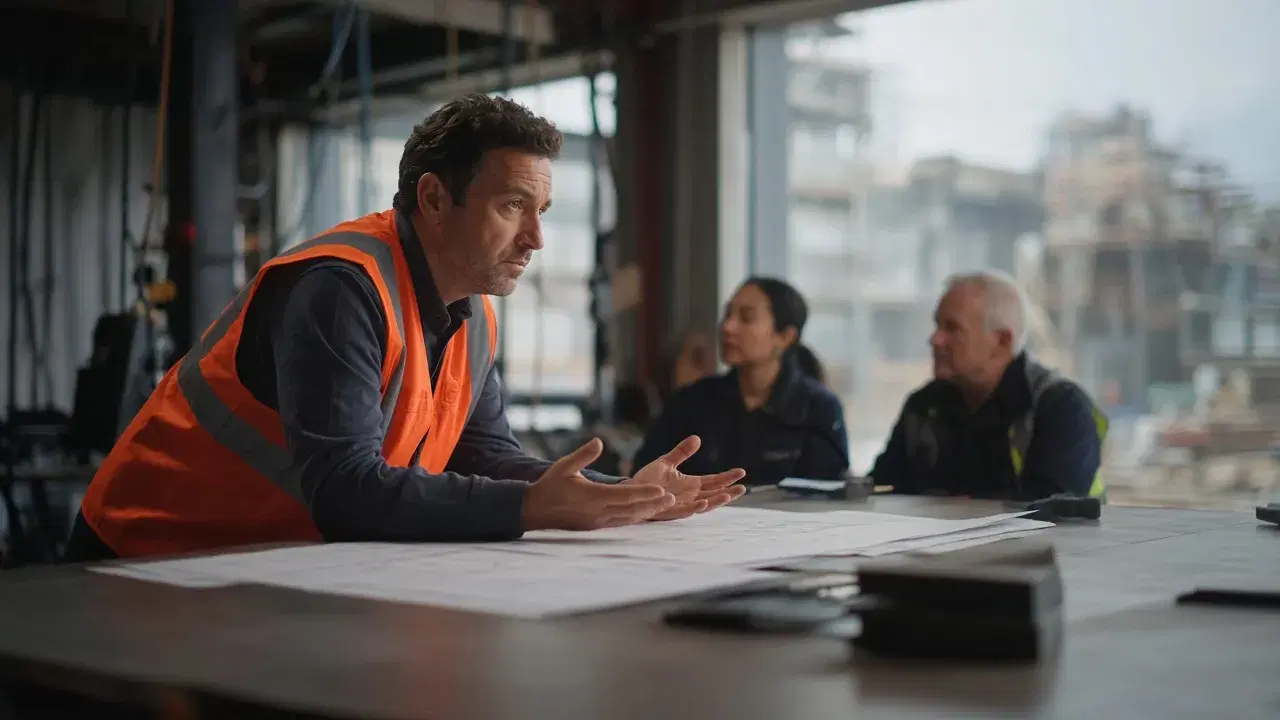
Consider a familiar scene. A steering committee sits down to review a major facility. The pack is tidy. Milestones are green. Interface risks are summarised in language that implies control. The package engineer who actually holds the risky sequence — a design release, an embedment, a cable pull, a commissioning window — is in the room or one call away. That engineer will not say “we do not know yet” in front of the owner. The miss surfaces after the gate, when float is gone and every admission becomes a commercial event.
Nothing in this pattern requires villains. The engineer is protecting a career, a firm and a claim position. The owner team is protecting a public date. The PMC is protecting facilitation. Each party “trusts” the others in a narrow sense: that someone will deliver because they are paid to, or because they delivered last time. What the room lacks is a different kind of trust — the confidence that peers’ intentions are good enough that a person can drop armour, admit a miss and ask for help before the miss becomes a crisis. Until that confidence exists, every progress meeting is partly a performance: people manage how they are seen rather than how the asset is actually doing.
On large capital projects of every kind — plants, terminals, rail systems, hospitals, data centres, ports — armoured meetings are common. Polished alignment is mistaken for health. Late bad news is treated as a surprise rather than as the predictable result of a room where vulnerability is unsafe. The failure is easy to misread as a soft-skills gap. It is not. It is a design gap: the project never made it rational, and rewarded, to say “I got it wrong” early.
The failure mode has a cost that projects rarely price. When armour is the default, risks travel in private channels, if they travel at all. Interface problems are discovered when two packages meet in the field rather than in a room where someone could have said “we are not ready.” Recovery then costs schedule, money and relationships — all of which would have been cheaper to spend on an early, awkward sentence.
The central claim of this blog is straightforward. On large capital projects, real trust is vulnerability-based trust. Predictive and contractual trust still matter. A learning climate for speak-up still matters. Neither substitutes for the willingness of people in delivery cells to expose uncertainty to one another without managing for effect. Without that foundation, debate stays artificial, commitment stays feigned and the asset pays later.
2. What Vulnerability-Based Trust Is — and What It Is Not
Vulnerability-based trust, in a team sense, is confidence that peers’ intentions are good, so members need not stay protective or careful with one another. Teammates get comfortable being vulnerable: admitting weaknesses, skill gaps, interpersonal shortcomings, mistakes and requests for help. That definition is precise. It is not a general warm feeling about the project, and it is not the same as believing a firm will perform.
Two other kinds of trust dominate large capital projects and must be kept distinct.
Predictive trust says: I expect quality work because past performance supports that expectation. It is desirable. Experienced crews earn it. It is still not the trust of a great team. A room full of people who predict one another’s delivery can still refuse to admit a current miss.
Contractual or commercial trust says: the agreement, the bond, the liquidated damages and the claims process will discipline behaviour. Large capital projects need that discipline. Commercial remedies do not create the conditions in which a supervisor says “we are uncertain about this geotech” in week three instead of week thirty.
Absence of vulnerability-based trust has a recognisable pattern. People conceal weaknesses and mistakes. They hesitate to ask for help or to offer it outside their own area. They jump to conclusions about others’ intentions. They waste energy managing for effect. They hold grudges and dread meetings. Presence has an equally recognisable pattern. People admit misses. They ask for help. They give the benefit of the doubt. They tap peers’ skills. They offer and accept apologies. They focus on issues rather than politics. They look forward to meetings that solve problems rather than stage performances.
A useful test on a large capital project is simple. In a joint room, when uncertainty appears, is the first move to clarify the unknown — or to protect the speaker’s firm and face? Another test: can a person raise a miss that implicates their own package without needing a private channel to survive? If not, predictive trust may be intact and vulnerability-based trust is not.
Vulnerability is not oversharing. It is not a demand that commercial negotiators abandon leverage in claim meetings. It is the narrower, harder practice of letting peers see enough of one’s real uncertainty and limits that the team can use the whole group’s skill. Teams that confuse vulnerability with indiscriminate confession burn trust. Teams that refuse any exposure starve it.
Figure 1: Two kinds of trust on large capital projects. Predictive and contractual trust rest on history and remedies; vulnerability-based trust rests on good intentions, admitting misses and asking for help. Both are needed; only the second drops the armour.
3. Why Armour Wins on Large Capital Projects
People stay invulnerable on large capital projects for structural reasons, not because they enjoy politics.
Claim and variation posture. Early admission of uncertainty can be read as entitlement for the other side. When every honest sentence risks becoming evidence in a dispute, armour is rational. Projects that never separate how admissions are treated commercially from how problems are solved technically teach people to stay quiet.
Home careers and matrix reporting. Many people are matrixed to the project while still rated by a functional manager or a home profit-and-loss account. Looking weak in front of the owner or a rival firm can cost a bonus or a promotion. The dotted line to the project loses to the solid line home.
Package prestige. Landmark schemes attract status. Belonging to the flagship can feel like enough; admitting a miss can feel like putting the flagship at risk. Individual and firm status crowd out the collective need to surface truth early.
Multi-logo rooms. Vulnerability shared across firm lines can be weaponised. A candid remark in a joint meeting can reappear in a letter. Without explicit rules for how candour is handled, people learn that armour travels better than honesty.
Punitive climates. When messengers of bad news are criticised, commercially squeezed or socially sidelined, talented people withhold. Owner–contractor chains under liquidated damages recreate that pattern easily: pressure from above, guerrilla silence from below, and a flaw that could have been caught early flying into execution. Historical mirror-test failures on major programmes have shown the same mechanism: relentless criticism of contractors teaches them to hide troubling results. “Do not shoot the messenger” is then a technical-risk control, not a slogan.
Partnering theatre. Multi-logo kick-offs and partnering charters create the appearance of trust without the practice of vulnerability. Predictive trust is celebrated; nobody practices saying “I got it wrong” in the room that matters.
Professional identity. Engineers, planners and commercial managers also carry discipline pride. A design lead may defend authorship; a planner may defend the baseline; a commercial lead may defend the purity of the file. Those identities are valuable. They become harmful when they outweigh the need to admit a cross-discipline miss at the moment of choice. Leaving unchecked discipline armour in place is another way logos stay on — not employer logos this time, but professional ones.
The result is a coalition of firms that looks coordinated and behaves as if every admission were a negotiation. Each package can be “green” while the asset drifts. Polished alignment is not health. It is armour with good formatting.
None of this requires bad faith. A package manager who withholds uncertainty is often protecting people whose ratings sit inside that package. A commercial manager who documents every admission is doing the job the contract describes. The failure is systemic: the project never made collective candour more important, more visible and more rewarded than looking strong. Until that changes, armour wins.
4. Not a Learning Climate by Another Name
A common confusion on large capital projects is to treat every speak-up problem as one problem. It is not. At least three related ideas travel together and must not be merged.
Vulnerability-based trust is confidence in peers’ good intentions so people drop armour — admit, ask, expose. It is other-focused in the sense that one trusts others’ motives. It enables the teamwork cascade that starts with candour and moves toward honest debate.
A learning climate for interpersonal risk — often discussed as psychological safety — emphasises near-term consequences of speaking up in service of learning: whether others will give you the benefit of the doubt if you raise a concern, ask a question or report an error. It is often a shared team climate. It is related to vulnerability-based trust and still a different construct. A room can feel relatively safe for learning behaviours and still lack peer vulnerability about skill gaps. People can trust one another’s intentions and still lack a climate that invites experiments and early error talk.
Agreement-keeping is trustworthiness through integrity: words match deeds; explicit and implicit agreements are kept; unfair agreements coerced under power imbalance undermine trustworthiness. Without that floor, vulnerability is exploited and armour returns. Agreement-keeping does not by itself create the willingness to admit a miss; it makes admission less dangerous.
Stack these deliberately. Do not synonymize them. This blog owns the vulnerability-based trust spine. Learning-climate depth belongs elsewhere. Integrity of agreements is the floor that keeps vulnerability from becoming a trap.
On large capital projects the confusion shows up as slogan stacking. Leaders announce that the site is a “speak-up culture,” hang partnering posters and then punish the first person who admits a package is not ready. Or they run a vulnerability exercise at kick-off and never keep the small agreements that make candour safe — start times, confidentiality, follow-through on raised risks. Or they keep agreements meticulously while never modeling the admission of a miss. Each failure mode looks like “we tried trust” and proves only that the wrong cousin was treated as the whole family.
Figure 2: Three cousins, not synonyms. Vulnerability-based trust, a learning climate for speak-up, and agreement-keeping are related and must not be merged. Large capital projects need the stack, not a single slogan.
5. The Door Trust Opens
Vulnerability-based trust matters because of what it unlocks next. Without it, productive disagreement about ideas rarely happens. People protect themselves. Meetings stay harmonious on the surface and political underneath. With it, members can debate knowing they will not be punished for seeming critical of a plan or a package.
Trust, conflict and interdependence travel together on the path toward a real team. That does not mean every meeting should be a fight. It means the absence of hard debate is not proof of alignment. On large capital projects, artificial harmony in progress meetings is a risk signal: interface truths stay with the people who fear looking disloyal to their firm.
This essay stops at the door. The craft of mining conflict, giving real-time permission to disagree, and restraining leaders from ending debate too early is a separate practice. So is the craft of peer accountability without blame. Vulnerability-based trust is the foundation those practices stand on. Building the foundation is not the same as running the debate.
One more caution. Trust without standards becomes cosiness. The point of dropping armour is not to avoid hard judgements about performance. It is to make those judgements possible on the basis of shared facts rather than protected narratives. Teams that never admit misses cannot hold one another accountable for results; they can only hold one another accountable for looking strong. Candour is the precondition for fair accountability, not its opposite.
6. Building It: The Leader Goes First
Vulnerability-based trust is built by design, not by a ropes course. The sequence matters.
The leader demonstrates vulnerability first. Genuine admission of uncertainty, a skill gap or a past miss sets the ceiling for everyone else. The environment must not punish that admission. Feigned vulnerability — theatrical confession without change — destroys trust faster than silence. On large capital projects the leader’s first admission is often about schedule optimism, an interface the owner team understaffed, or a decision taken too early. The content matters less than the signal: looking strong is not the job; getting the asset right is.
Short personal histories. Brief humanising exchanges — hometown, first job, a challenge overcome — help people see one another as more than logos and roles. This is not therapy. It is a fast way to reduce the assumption of bad intent.
A team effectiveness exchange. Peers name one another’s single biggest contribution to the team and one area to improve. The exercise forces positive recognition and constructive candour in the same conversation. Done well, it normalises feedback without turning it into a compensation event.
Shared behavioural language. Light use of profiles or style lenses can give a team a vocabulary for difference. Profiles are tools for understanding, not destiny. They help only when layered on fundamentals.
Feedback divorced from pay when it is about trust. When multi-rater feedback is used to build candour, tying it immediately to compensation teaches people to manage the instrument rather than tell the truth.
Infrastructure that assumes good faith. Goals, roles and rules agreed early create clarity; clarity reduces the need for armour. Explicit rules about respect and trust — confidentiality in the room, punctuality, no sarcasm as a weapon, assume good faith when conflict appears — make vulnerability safer. Team-level process check-ins (what worked, what to change) build skill before harder individual conversations.
Keep agreements. Integrity is the floor. If leaders ask for candour and then use admissions against people, or break small commitments while preaching openness, armour returns. Trustworthiness judged by actions versus intentions is not a soft idea; it is operational.
Make it a habit under pressure. A single offsite does not create vulnerability-based trust. Delivery months do. The practice has to survive delay, claims heat and membership change. When major packages join or leave, rebuild the agreements and restate that admitting a miss early is valued.
Recognise the behaviour you want. What leaders celebrate becomes what people protect. Awards and steering slides that praise only green packages teach armour. Recognition for early warning, cross-firm help-seeking and clean apologies teaches vulnerability-based trust. The calendar of praise is part of the design.
Design conditions still matter. If membership is unclear, purpose is a slogan and organisational rewards punish honesty, vulnerability exercises become theatre. A project that rates people only on looking unshakeable while asking them to admit misses has already chosen which instruction will be obeyed. Fix the conditions; then practice candour.
Thinking out loud helps. When leaders narrate their reasoning — including doubts — they make uncertainty normal rather than shameful. Care for people is not separate from trust; people take interpersonal risks more readily when they believe leaders will not discard them for an early honest sentence. Those practices support vulnerability-based trust; they do not replace the explicit work of admitting misses in the room.
Figure 3: A leader-goes-first gate for vulnerability-based trust. The leader admits first; histories and effectiveness exchanges follow; good-faith rules and kept agreements make candour usable under pressure. If a messenger is punished, armour returns and the gate must be reopened.
7. Trust Across Firms Without Softening the Contract
Large capital projects need both commercial discipline and vulnerability-based trust. Confusing the two helps nobody.
Contracts still allocate risk. Bonds, remedies and claims processes still matter. Vulnerability does not erase entitlement discipline, and it should not. What projects need is a clear separation: how admissions are treated when the job is to solve a technical or interface problem, versus how commercial positions are recorded. Without that separation, every “I got it wrong” becomes a letter.
Inside delivery cells — interface crews, commissioning teams, recovery war rooms — people from many employers must still be able to say “we are uncertain” and “we need help” without that sentence becoming a claim weapon by default. Clear room rules, leaders who go first across firm lines, and recognition for early warning rather than only for green package reports make that possible. Some projects wall commercial warfare off from delivery collaboration with explicit protocols: problem-solving sessions are for facts and options; commercial positions are recorded in a separate track. Where that wall is missing, vulnerability-based trust dies at the first heated interface.
Owner behaviour sets the tone. Leaders who listen after forming a view, who visit relationships after award rather than only before, and who treat soft skills as hard work create conditions in which vulnerability is less dangerous. Technical savvy alone does not produce that climate. Neither does a partnering poster. Openness and emotional skill in owner leadership show up repeatedly in industrial project research as correlates of better outcomes — not because they replace front-end discipline, but because they make integrated teams and honest information more likely. Vulnerability-based trust is one of the mechanisms through which that soft side becomes hard results.
Multi-firm identity — treating the project as the “us” people work for during delivery — makes vulnerability less dangerous because admissions are less easily read as betrayal of a home logo. Identity redesign is a related essay. Here it is only an enabler: vulnerability-based trust is harder when everyone still works primarily for their jacket.
Steering level and delivery cells may need different social technologies. A large steering group of accountable individuals can operate as a strong working group with clear individual ownership and still require vulnerability about uncertainty at the points that matter. Forced “we are one big family” language across hundreds of people without cell-level practice produces another pseudo-team. Build vulnerability-based trust where mutual work products exist — then connect those cells with rules that stop armour from reforming at every interface.
Figure 4: Trust layers on a large capital project. Contractual and predictive trust sit outside; vulnerability-based trust lives in delivery cells; a learning climate for speak-up sits adjacent and must not be collapsed into trust. Stack the layers; do not ask vulnerability to replace the contract.
8. Say It Before the Debate
Large capital projects do not fail only from thin definition or weak schedules. They fail quietly when capable people manage for effect instead of admitting the miss. Vulnerability-based trust is the foundation that makes honest conflict possible. It is not predictive trust. It is not a soft contract. It is not a learning climate by another name. Leaders go first. Systems must not punish the first honest sentence. Agreements must be kept so candour is not exploited.
The work is ordinary and relentless: practice saying “I got it wrong” in rooms that matter, reward early warning, separate problem-solving admissions from commercial warfare, and rebuild the practice when membership changes. Done early, it is cheaper than the average late surprise. Done never, the pack stays green until it cannot.
Leaders who want real trust should listen for the first honest sentence in their next progress meeting — and notice what happens next. If the room flinches, armour is still the rational strategy. If the room leans in, the foundation is starting to hold.
A shared date without shared candour is a schedule nobody will defend with the truth. The sentence that matters, before the debate begins, is the one that drops the armour.
References
- Lencioni, P. The Five Dysfunctions of a Team (2002)
- Edmondson, A. “Managing the Risk of Learning” (Harvard Business School, 2002)
- Katzenbach, J. R., & Smith, D. K. The Wisdom of Teams
- Pellerin, C. J., Jr. How NASA Builds Teams (2009)
- Shapiro, M. HBR Guide to Leading Teams (2015)
- Marquet, L. D. Turn the Ship Around! (2012)
- Merrow, E. W., & Nandurdikar, N. S. Leading Complex Projects (2018)
- Flyvbjerg, B., with Gardner, D. How Big Things Get Done (2023)
- Coyle, D. The Culture Code
- Hackman, J. R., & Wageman, R. Team effectiveness conditions
- Benator, B., & Thumann, A. Project Management and Leadership Skills for Engineering and Construction Projects (2003)
- Google Project Aristotle / re:Work (corporate summary)